How Not to Become a Grumpy Old Bugger, Geoff Hutchison

But does the book live up to the catchy title? (At this point, we should explain to any international readers that ‘bugger’ is a common term of endearment in Australia, along with ‘bastard’ and some less commonly employed ones like ‘drongo’.) The answer is ‘sort of’.
On the plus side, it’s a fun, relatively light read that asks why so many men end up unhappy later in life and offers a range of practical solutions. Hutchison starts by observing how discontent his own father often was, then rattles through the many things that can make a man miserable, from work, money and politics to friendships, retirement, the internet and sexual health (think the sort of issues that lead a man to ask for a Viagra prescription).
The insights and solutions in the book come from Hutchison, who was an ABC Radio presenter for many years in Australia, and a range of experts and subjects he interviewed. In places, he also includes material written by those third parties, who include everyone from a financial adviser to one of his children. This provides a rich range of perspectives and different voices, not unlike a radio show, in fact.
On the less-plus side, the wide range of topics and voices make the book a lumpy read and some topics appear to have been included more because they’re things that bother the author more than being core to the argument. This raises the central irony of the book, being that Hutchison is, essentially, grumpy about grumpiness. I never quite got past this inherent contradiction, but I did finish the book and found it amusing and thought-provoking, even as it often annoyed me. Perhaps that just means I’m already grumpy.
By Grant Butler
Great Writers and the Cats Who Owned Them, Susannah Fullerton
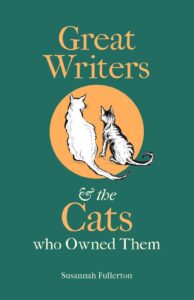
Fullerton profiles 17 writers through the cats that shared their lives and occasionally wandered into their work. The book spans multiple periods and places, yet it doesn’t feel heavy. One chapter features the French novelist, Colette, and her much-loved cats, Kiki-la-Doucette and La Chatte. Another looks at Ernest Hemingway, who at one point lived with 54 cats.
Some accounts stand out because the writers were characters themselves. Poet Robert Southey, for example, gave his cat, Rumpelstilzchen, a long string of titles – The Most Noble the Archduke Rumpelstiltzchen, Marquis Macbum, Earl Tomlemagne, Baron Raticide, Waowhler and Skaratch. Another cat in his household rose from Lord Nelson to Earl Nelson as he became better at mousing.
The book also notes the harsher realities of earlier periods. In 19th-century England, before veterinary clinics were common, seriously ill cats were often put down by drowning or shooting because few other options existed.
Even if you’re not a cat person, the combination of literary anecdotes and feline quirks makes the book an amusing read.
By Manuelita Contreras
Perfection, Vincenzo Latronico
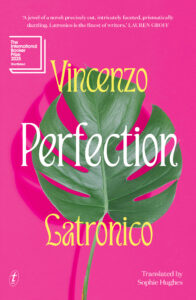
The novel’s indivisible protagonists, Anna and Tom, are mirrors for the reader, and if they lack depth, it’s by design. The artefacts and cultural signifiers that surround and define them – the digital nomad lifestyle, the studied shabby-chicness of their apartment (antique floorboards, curated kitchen appliances, a seldom-used printer in the corner), the plant-filled cafés, the lurking obsession with real estate – are immediately recognisable, and the reflection becomes increasingly distorted and unpalatable on too-close inspection.
Perfection is a slim novel, and it moves at a swift pace befitting of protagonists who lack the capacity for introspection but carry on regardless. Having read all of the above, you might think this is a negative review, but the book is perversely satisfying, like the proverbial train wreck you just can’t look away from. It’s also a welcome invitation to acknowledge and laugh at the absurdity of modern life – the cobbled-together reality behind the ‘perfect’ façade. Whether the joke’s on Anna and Tom or on us (both can be true), through the lens of Perfection we’re all in on the joke together.
By Olivia McDowell
Sea of Tranquility, Emily St. John Mandel
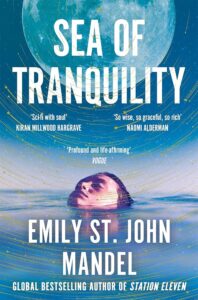
As one hopes for in good speculative fiction, the worlds in Sea of Tranquility are both deeply familiar and elegantly off kilter. Characters and events separated by centuries and light-years subtly work their way into each other’s orbits, pulling us towards a single coalescing storyline. The characters and their mysteries are best discovered as you encounter them, though it’s not giving too much away to say that there is time travel – and the book makes time travellers of us all as we shift back and forth within its internal timeline.
Sea of Tranquility is a page-turner but a wholly engrossing one – possible to read in a couple of eager, immersive sittings. It’s also the kind of book that makes you want to read everything else the author has written, even before you’ve reached the last page. The good news is that I’m late to the party and this is St. John Mandel’s sixth novel, so there’s no shortage of material for the to-read-right-now list. (I’ve got my sights set on Sea of Tranquility’s highly acclaimed precursor, Station Eleven.)
By Olivia McDowell
Notes to John, Joan Didion
The subject is Quintana, the couple’s adopted daughter, who has become a depressed alcoholic. Besides the jet-setting and name-dropping, we learn there is little glamour in their lives. Quintana lurches between quitting and lapsing; between needing her parents and pushing them away. Psychiatrist Dr Roger MacKinnon, quoted verbatim throughout, circles above. Is it something about Didion’s past? Always needing order? Sheltering in her work?
The sessions with Dr MacKinnon quoted in the book took place from 2000 to early 2002. Readers of The Year of Magical Thinking, written between Dunne’s death in 2003 and Quintana’s in 2005, know it will only get worse for Didion before it gets better. And Notes to John (HarperCollins, 2025) is not exactly an endorsement for the laser precision of psychoanalysis – Didion saw MacKinnon for another 10 years.
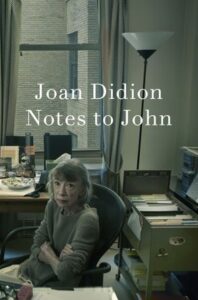
Pictured on the cover alongside her ashtray and Winston Lights, Didion has a look on her face as if to say, “Well, now you know everything”. She died in 2021, never intending these notes to be published.
By Jeremy Chunn
The Names, Florence Knapp
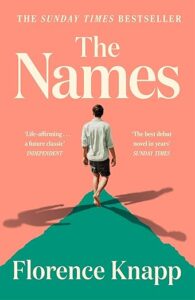
From that single choice – between Bear, Julian and Gordon – the novel splits into three parallel realities, each tracing how the boy’s life unfolds over decades. Knapp uses this structure to explore identity, trauma and domestic violence.
The Names is deeply engaging because it resists tidy resolution. Although the premise is complex, the characters feel authentic; they falter, suffer and fight for autonomy. Knapp’s prose is measured and lucid, her handling of shifting timelines assured and precise.
Ultimately, The Names is a haunting and thoughtful exploration of naming, legacy and choice. It suggests that while a name may not determine a life, the decisions we make – and the courage it takes to make them – carry immense weight.
By Ylla Watkins
Wild Dark Shore, Charlotte McConaghy
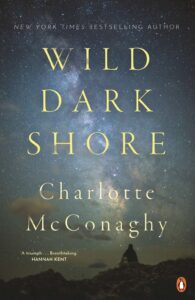
Wild Dark Shore (Penguin, 2025) sublimely portrays beauty and terror, love and grief, nature and nurture. McConaghy describes the island in granular detail (she modelled it on Macquarie Island, which she visited for her research). The reader is there, gazing at the black beaches packed with seals and penguins, and wading through the floodwater in the seed vault, selecting the specimens that must be saved.
The characters are all complex and interesting. Barring one, they are likeable or even lovable. Take Orly, a clever nine-year-old who is an expert on the seeds and animals. He can hear the tortured cries of the dead animals in the wind (like Macquarie Island, the penguins and seals on Shearwater had been massacred, their blubber rendered for oil).
The writing is so beautiful that it saves the novel from being overwhelmed by the bleakness of the themes. I’m in awe of McConaghy’s talent and can’t wait to read her other books.
By Kim Irving
Lyrebird, Jane Caro
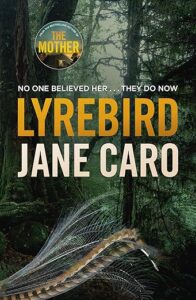
Fast-forward 20 years, and human remains are found in the same area after a landslide, drawing Megan, now retired, back into the cold case. She is aided by Jessica, now an associate professor.
As the horizon shimmers with the threat of bushfires, Megan is determined to find the killer – whatever it takes.
Lyrebird (Allen & Unwin, 2025), the second novel from social commentator Jane Caro, is that rare type of crime novel that weaves crime investigation with a profound awareness of the natural environment. The Australian bush is depicted as both beautiful and dangerous, enhancing the sense of unease, and the lyrebird serves as a haunting witness to human brutality.
Caro handles heavy themes – including human trafficking, gendered violence and climate change – with respect and restraint. The pace accelerates as Megan digs into the mystery, but the novel never strays far from its core questions: what happens when violence is ignored or silenced? Can the natural world bear witness to human cruelty? And what is justice, and who gets to tell the story?
While there is much for lovers of crime fiction in this gripping novel, Caro’s voice elevates the familiar into something contemplative and unsettling.
By Ylla Watkins
The Book of Guilt, Catherine Chidgey
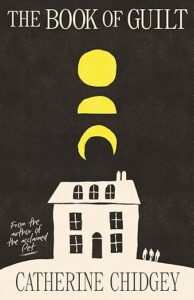
Thirteen-year-olds Vincent, Lawrence and William spend their days learning lessons from the ‘Book of Knowledge’, doing chores and taking their medicine, always under the watchful gaze of three mothers – Mother Morning, Mother Afternoon and Mother Night. The boys’ dreams are recorded each morning in the ‘Book of Dreams’, while their misdeeds are noted in the ominously titled ‘Book of Guilt’.
All the boys want is to be sent to Margate, where they believe a seaside paradise awaits children good enough to be chosen. But as the government moves to shut down the Sycamore Homes and dark secrets emerge, the triplets begin to question everything they know.
Equal parts coming-of-age story and dystopian allegory, The Book of Guilt is an unsettling examination of what it means to be human, institutional cruelty and the moral implications of societal complicity. It will stay with you long after you finish the last page.
By Ylla Watkins
Do We Deserve This? Eleanor Elliot Thomas
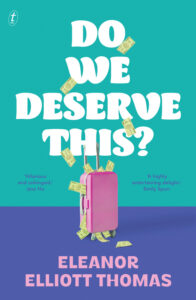
What would you do if you bought your mum a winning lottery ticket worth millions, only for her to fall into a coma before you could tell her? Would you honour your original intention, or would years of being an underachiever compared to your two older siblings finally entitle you to something for yourself? Set against an Australian backdrop, Eleanor Elliot Thomas’s debut novel, Do We Deserve This? (Text Publishing, 2025), uses this impossible question to excavate all the complicated layers of family obligation, resentment and love that make such a scenario a moral nightmare.
Bean Halloway faces exactly this dilemma. As she navigates her mother Nina’s medical crisis alongside her golden-child brother, Jeremy, and her difficult sister, Genevieve, the lottery money becomes more than just a windfall. It’s a mirror reflecting long-buried resentments and unresolved tensions. Bean’s internal battle between doing what’s expected and claiming something for herself feels painfully authentic.
Thomas captures the contradictions inherent in family life beautifully. There are no villains here, no easy answers. Instead, she shows us how people who genuinely love each other can also hurt each other, how years of small sacrifices can accumulate into enormous grievances, and how the roles we play in our families can both define us and trap us.
The dark comedy throughout keeps the story from feeling too heavy, but underneath the humour lies real emotional weight. Thomas asks difficult questions about privilege, obligation and whether we ever truly escape our family patterns. The novel uses the lottery as a lens to examine who deserves what – and why.
Do We Deserve This? doesn’t provide neat resolutions. Instead, it lays bare the beautiful, frustrating complexity of family bonds and asks the reader to sit with the discomfort. For anyone who’s ever felt caught between family obligation and personal desire, this book will resonate long after the final page.
By Elmandi du Toit